How to Add a Resume to LinkedIn Profile (Step-by-Step Guide 2026)

Adding your resume to LinkedIn is one of the fastest ways to get noticed by recruiters. It takes less than two minutes, and it can turn a passive profile view into a real job opportunity. But LinkedIn actually offers three different places to upload your resume, and each one serves a very different purpose.
In this 2026 guide, you will learn exactly how to add your resume to your LinkedIn profile, when to make it public, when to keep it private, and how to use LinkedIn's new AI resume assistant to tailor it to every job you apply for.
Can you upload a resume to LinkedIn?
Yes. LinkedIn lets you upload a resume to your profile in PDF, DOC or DOCX format (up to 5 MB). You can either display it publicly as a featured post on your profile, store it privately in your Easy Apply settings for one-click job applications, or let LinkedIn's AI resume assistant generate a tailored version from your profile.
The method you choose depends on your goal. If you want visibility, use the featured post. If you want to apply faster, use Easy Apply settings. If you want a perfectly tailored document for a specific job, use the AI assistant.
3 ways to add your resume to LinkedIn (overview)
Here is a quick comparison of the three methods so you can pick the one that fits your situation.
| Method | Visibility | Best for |
|---|---|---|
| Featured post | Public (everyone) | Job seekers actively looking |
| Easy Apply settings | Private (only you and the recruiter you apply to) | Candidates applying to many jobs |
| AI resume assistant | Private, generated per job | Tailoring resumes to each application |
Most people only know method 2. Methods 1 and 3 are where the real advantages lie in 2026, so we will cover all three in detail.
Method 1: Upload your resume as a featured post (step-by-step)
The featured section sits at the top of your LinkedIn profile, right under your About section. It is the first thing recruiters see after your headline, which makes it the perfect place to display your resume when you are actively job hunting.
Here is how to add your resume as a featured post, step by step:
- Go to your LinkedIn profile by clicking your photo in the top navigation bar.
- Click Add profile section, then choose Recommended > Add featured.
- In the Featured panel, click the plus icon (+) and select Add media.
- Upload your resume file. LinkedIn accepts PDF, DOC and DOCX formats up to 5 MB. PDF is strongly recommended because it preserves formatting across all devices.
- Add a clear title (for example: "Senior Marketing Manager Resume - 2026") and a short description highlighting your specialty, years of experience and what role you are looking for.
- Click Save, then preview your profile as a visitor to make sure the resume displays correctly.
Once saved, your resume appears as a thumbnail in your Featured section. Anyone visiting your profile can click it to open and download the file. This is why you should remove sensitive personal information before uploading, such as your home address, personal phone number and date of birth.
Join them today and boost your LinkedIn prospecting.
Method 2: Add resume to Easy Apply settings for job applications
This second method is the most practical one if you are actively applying for jobs. LinkedIn stores your resume in your Job Application Settings, and every time you click Easy Apply on a job post, LinkedIn pre-fills your application with the stored file.
Here is how to set it up:
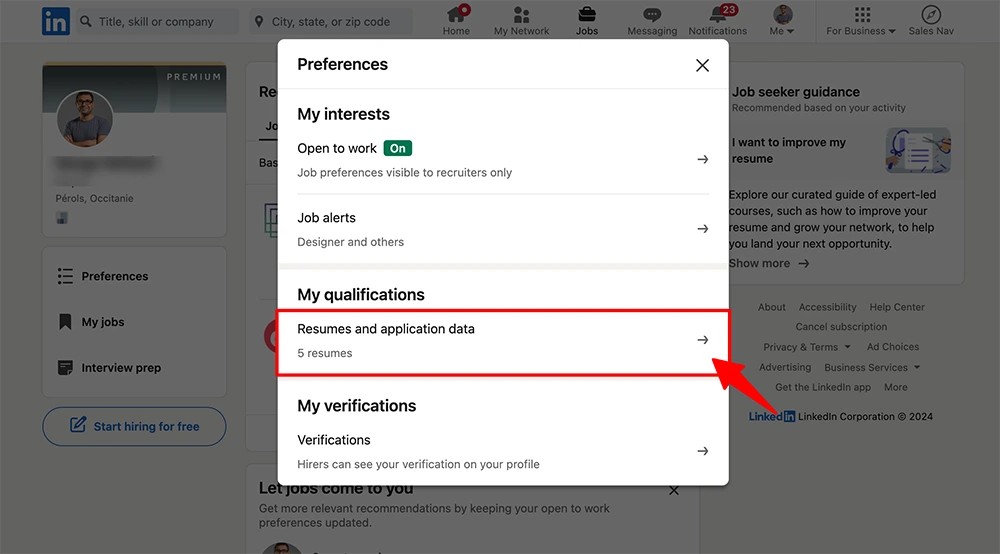
- Open LinkedIn and click Jobs in the top navigation bar.
- Click Preferences in the left sidebar.
- Under My qualifications, click Resume and Application Data.
- Click Upload Resume and select your file from your computer. Accepted formats: DOC, DOCX or PDF, up to 5 MB.
- LinkedIn keeps your four most recent resumes, so you can switch between versions depending on the role you apply for.
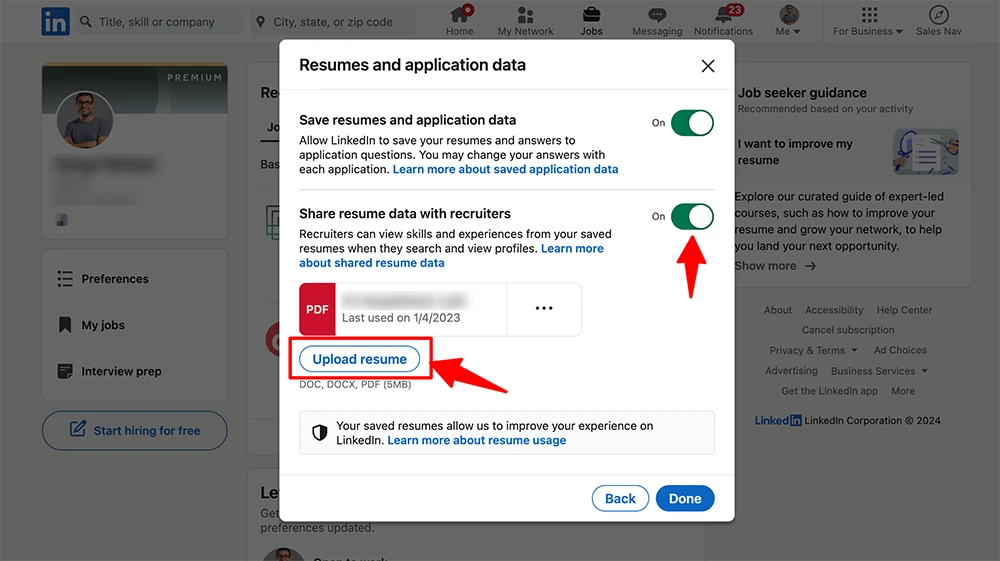
The big advantage of this method is privacy. Your resume is not visible on your public profile. It is only shared with the recruiter when you click Submit on an Easy Apply job. This is the safest option if you are still employed and do not want your current company to see that you are looking.
One practical tip: keep one generic version for Easy Apply speed, and one specialized version for senior or technical roles. Switching between them takes two clicks.
Method 3: Use LinkedIn's AI resume assistant (new 2026 feature)
Launched broadly to Premium members in early 2026, LinkedIn's AI resume assistant is the most powerful way to generate a tailored resume in seconds. It reads your LinkedIn profile, analyzes the job description you are targeting, and produces a ready-to-send resume aligned with the recruiter's exact requirements.
Here is how to use it:
- Open any job post on LinkedIn that has the Easy Apply button.
- Click Easy Apply, then look for the Tailor with AI button (visible to Premium subscribers) under the Resume section.
- LinkedIn's AI reads the job description and your profile, then generates a resume draft that rewords your experience to match the job's key skills.
- Review the suggestions. You can accept, edit or reject each bullet point individually.
- Download the generated PDF, or attach it directly to your application.
This feature works because it matches the keywords recruiters are searching for inside LinkedIn Recruiter, which dramatically increases the chances of landing in the shortlist. If you apply to many jobs per week, the AI assistant cuts tailoring time from 20 minutes per application to under 2 minutes.
Keep in mind: the AI only writes as well as your profile is filled out. If your LinkedIn profile is thin, the generated resume will be thin too. Before using the assistant, make sure your profile has a strong headline, a detailed About section, and complete experience entries.
How to remove or update your resume on LinkedIn
Resumes go out of date fast. Here is how to keep yours fresh on both methods.
To update or remove your resume in Easy Apply settings:
- Go to Jobs > Preferences > Resume and Application Data.
- Next to the outdated file, click the three-dot menu and select Delete to remove it, or Upload Resume to add a newer version.
- LinkedIn automatically replaces the oldest file when you exceed the four-resume limit.
To update or remove your resume from your Featured section:
- Go to your profile and scroll to the Featured section.
- Click the pencil icon in the top right corner of the Featured panel.
- Click the pencil icon next to the resume you want to edit, or the trash icon to remove it.
- To replace it, click Save, then re-upload the new version using the plus icon.
Update your resume at least twice a year, and always after a role change, a certification or a major project. Recruiters open LinkedIn profiles before reading a resume, but once they click the file, they expect the two to match perfectly.
Should you add your resume to your LinkedIn profile?
Short answer: it depends on your job search status.
Add it publicly if you are actively looking. A visible resume in your Featured section signals to recruiters that you are available and ready to be contacted. It also speeds up their decision to reach out, because they can download your file without asking.
Keep it private if you are passively open. If you have a job and do not want your current employer to find out you are exploring, use the Easy Apply method. Your resume stays hidden from public view.
Skip it altogether if your profile is already doing the work. A well-optimized LinkedIn profile with a clear headline, a detailed About section and specific experience bullets often performs better than a static PDF. If your profile is strong, you may not need a resume at all.
For most candidates, the best approach is a hybrid: keep a tailored resume in Easy Apply for fast applications, and only display it publicly when you are in active search mode.
Resume vs LinkedIn profile: what's the difference?
A resume and a LinkedIn profile look similar, but they serve very different purposes. Understanding this difference helps you decide where to invest your time.
A resume is a static, one-to-two page document tailored to a specific job. It is written in formal language, uses bullet points, and is designed to be scanned in 6 seconds by a recruiter or an applicant tracking system. Each resume is customized per application.
A LinkedIn profile is a dynamic, always-on professional page. It supports rich media, recommendations, endorsements and activity. Recruiters use it to verify your background, see your network and judge your thought leadership. A LinkedIn profile is also crawled by search engines, which means it appears in Google results when someone searches your name.
The practical takeaway: your LinkedIn profile should tell the long version of your story, while your resume is the short, tailored pitch. Both should be consistent, but they are not interchangeable.
Join them today and boost your LinkedIn prospecting.
LinkedIn profile optimization tips for job seekers
Uploading a resume is just one piece of the puzzle. If you really want recruiters to find you, your full profile needs to be optimized for LinkedIn's search algorithm. Here are the high-impact changes that make the biggest difference in 2026:
- Write a keyword-rich headline. Instead of "Marketing Manager at Company X", use "Senior Marketing Manager | B2B SaaS | Demand Generation & Paid Social". Recruiters search by keywords, not job titles.
- Turn on Open to Work. This green signal tells LinkedIn Recruiter you are available. You can make it visible only to recruiters to stay discreet.
- Customize your URL. A clean URL like linkedin.com/in/yourname looks professional on your resume and email signature.
- Add a banner image. A simple, on-brand banner instantly makes your profile look more credible than the default blue background.
- Request recommendations. Three to five recent recommendations from managers, colleagues or clients add social proof that no resume can replicate.
- Post once a week. Even a single short post per week increases your profile views by 3 to 5 times, according to LinkedIn's own creator data.
If you want to dig deeper into how recruiters use LinkedIn, read our guide on LinkedIn account types and which one suits you, and see how Kanbox helps recruiters and job seekers connect in our LinkedIn recruitment guide.
Frequently Asked Questions
How do I upload my resume to LinkedIn?
Go to your profile, click Add profile section, then Recommended, then Add featured. Click the plus icon and choose Add media. Upload a PDF, DOC or DOCX file under 5 MB. For private Easy Apply uploads, go to Jobs > Preferences > Resume and Application Data instead.
Should I add my resume to my LinkedIn profile?
Yes, if you are actively job hunting. A public resume in your Featured section speeds up recruiter outreach. If you are passively open, use the Easy Apply method so your resume stays private and only visible to the recruiter when you apply.
Can I add multiple resumes to LinkedIn?
Yes. LinkedIn's Easy Apply settings store up to four resumes at a time. You can switch between them before submitting each application, which is useful if you apply to different types of roles or industries.
What file format does LinkedIn accept for resumes?
LinkedIn accepts PDF, DOC and DOCX files up to 5 MB. PDF is strongly recommended because it preserves your formatting, fonts and layout on every device and is the format most applicant tracking systems prefer.
Is my uploaded resume visible to everyone?
It depends on the method. A resume added via the Featured section is public and visible to anyone, including people outside your network. A resume uploaded via Easy Apply settings stays private and is only shared with the recruiter when you click Submit on a job.
How do I update my LinkedIn resume?
For Easy Apply, go to Jobs > Preferences > Resume and Application Data, click the three-dot menu next to the old file and choose Delete, then upload the new version. For the Featured section, click the pencil icon on the Featured panel and replace the old media.
How do I remove my resume from LinkedIn?
In Easy Apply settings, click the three-dot menu next to the resume and select Delete. In the Featured section, click the pencil icon on the Featured panel, then click the trash icon next to the resume file to remove it from public view.
What is the difference between a resume and a LinkedIn profile?
A resume is a static, tailored one-to-two page document for a specific job. A LinkedIn profile is a dynamic, always-on professional page with rich media, recommendations and activity. Both should be consistent, but they are not interchangeable.
Does LinkedIn have an AI resume builder?
Yes. LinkedIn's AI resume assistant, available to Premium subscribers since early 2026, reads your profile and the target job description, then generates a tailored resume draft in under a minute. You can edit each bullet point before downloading the PDF.
Is it safe to upload my resume to LinkedIn?
It is safe as long as you remove sensitive personal data before uploading. Delete your home address, personal phone number and date of birth. If you are worried about your current employer seeing it, use the private Easy Apply method instead of the public Featured section.
Kanbox automates your LinkedIn actions so you can focus on what really matters.
Frequently Asked Questions
Go to your profile, click Add profile section, then Recommended, then Add featured. Click the plus icon and choose Add media. Upload a PDF, DOC or DOCX file under 5 MB. For private Easy Apply uploads, go to Jobs > Preferences > Resume and Application Data instead.
Yes, if you are actively job hunting. A public resume in your Featured section speeds up recruiter outreach. If you are passively open, use the Easy Apply method so your resume stays private and only visible to the recruiter when you apply.
Yes. LinkedIn's Easy Apply settings store up to four resumes at a time. You can switch between them before submitting each application, which is useful if you apply to different types of roles or industries.
LinkedIn accepts PDF, DOC and DOCX files up to 5 MB. PDF is strongly recommended because it preserves your formatting, fonts and layout on every device and is the format most applicant tracking systems prefer.
It depends on the method. A resume added via the Featured section is public and visible to anyone, including people outside your network. A resume uploaded via Easy Apply settings stays private and is only shared with the recruiter when you click Submit on a job.
For Easy Apply, go to Jobs > Preferences > Resume and Application Data, click the three-dot menu next to the old file and choose Delete, then upload the new version. For the Featured section, click the pencil icon on the Featured panel and replace the old media.
In Easy Apply settings, click the three-dot menu next to the resume and select Delete. In the Featured section, click the pencil icon on the Featured panel, then click the trash icon next to the resume file to remove it from public view.
A resume is a static, tailored one-to-two page document for a specific job. A LinkedIn profile is a dynamic, always-on professional page with rich media, recommendations and activity. Both should be consistent, but they are not interchangeable.
Yes. LinkedIn's AI resume assistant, available to Premium subscribers since early 2026, reads your profile and the target job description, then generates a tailored resume draft in under a minute. You can edit each bullet point before downloading the PDF.
It is safe as long as you remove sensitive personal data before uploading. Delete your home address, personal phone number and date of birth. If you are worried about your current employer seeing it, use the private Easy Apply method instead of the public Featured section.